Batch vs Realtime Data Pipelines: Which One Do You Need?
Not sure whether to build a batch or realtime pipeline? This guide breaks down the differences, trade-offs, and exactly when to use each approach.
One of the most common questions we hear from engineering teams is: "Should we build a batch pipeline or a realtime pipeline?" The answer isn't always obvious, and choosing the wrong approach can cost you months of rework. This guide will help you make the right decision.
The Core Difference
Batch pipelines process data in chunks at scheduled intervals — every hour, every night, every week. Think of it like doing your laundry: you let it pile up and then run a full load once you have enough.
Realtime pipelines (also called streaming pipelines) process data continuously as it arrives — within milliseconds or seconds. Think of it like a conveyor belt in a factory: items move through the moment they arrive.
How Batch Pipelines Work
A batch pipeline typically follows this pattern:
- Data accumulates in a source (database, files, API)
- At a scheduled time, the pipeline kicks off
- It reads all the new data since the last run
- Transforms and processes it
- Loads it to the destination
- Waits for the next schedule
Common tools: Apache Spark, AWS Glue, dbt, Apache Airflow, SQL scripts
Example use case: Every night at 2 AM, pull all orders from the past 24 hours from your PostgreSQL database, calculate revenue metrics, and load them into your data warehouse for the morning business report.
How Realtime Pipelines Work
A realtime pipeline follows a different pattern:
- Data is produced by a source and immediately published to a message queue (Kafka, Kinesis)
- A stream processor picks up each event as it arrives
- Transforms and enriches it in memory
- Pushes results to the destination within milliseconds
Common tools: Apache Kafka, AWS Kinesis, Apache Flink, Spark Streaming, AWS Lambda
Example use case: Every time a user clicks "buy" on your e-commerce site, instantly update their loyalty points, trigger a confirmation email, and update the inventory count — all within 100ms.
Comparing the Two Approaches
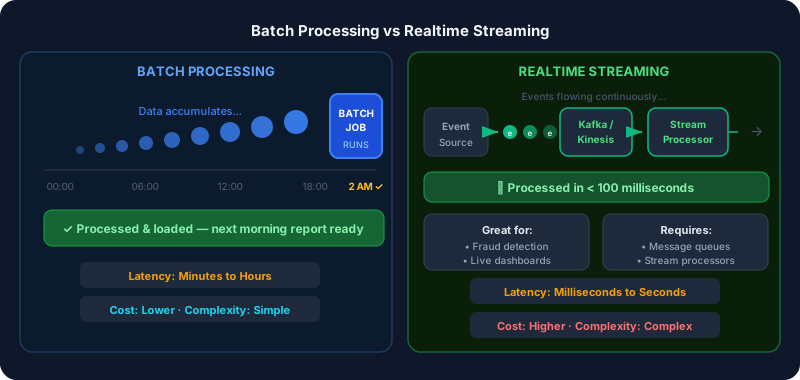
| Factor | Batch | Realtime | |---|---|---| | Latency | Minutes to hours | Milliseconds to seconds | | Complexity | Lower | Higher | | Cost | Lower | Higher | | Debugging | Easier | Harder | | Data volume | Handles large volumes well | Better for lower volume, high frequency | | Infrastructure | Simpler | Requires message queues, stream processors | | Use cases | Reports, analytics, ETL | Fraud detection, notifications, live dashboards |
When to Use Batch Processing
Batch is the right choice when:
Your data consumers don't need immediate results. If your business analysts look at yesterday's sales report every morning, there's no need to process data in realtime. A nightly batch job is simpler and cheaper.
You're processing large volumes of historical data. Batch is much more efficient for processing terabytes of data. Realtime systems are designed for high-frequency, lower-volume streams.
Your use case tolerates latency. Monthly billing runs, daily recommendation updates, weekly cohort analysis — all of these are perfect for batch.
You're building your first pipeline. Batch pipelines are significantly easier to build, test, and debug. Start here unless you have a clear realtime requirement.
Cost is a concern. Batch jobs run periodically and you pay for compute only when they run. Realtime infrastructure (Kafka clusters, stream processors) runs 24/7.
When to Use Realtime Pipelines
Realtime is the right choice when:
Seconds matter for user experience. Fraud detection, ride-sharing driver matching, live auction bidding — these require immediate action. A batch job that runs every hour is useless for fraud that happens in seconds.
You need live dashboards. If your operations team needs to see what's happening right now — active users, live inventory, real-time revenue — you need streaming.
You're reacting to events. Sending a push notification when someone's package is delivered, triggering an alert when a server goes down, updating a customer's account the moment a payment clears — these are event-driven use cases that need realtime.
You're doing IoT data processing. Sensor data from devices needs to be processed as it comes in, not hours later.
The Hybrid Approach: Lambda Architecture
In practice, many production systems use both. This is called the Lambda Architecture:
- Batch layer: Processes all historical data accurately (runs nightly/hourly)
- Speed layer: Processes recent data in realtime (last few minutes)
- Serving layer: Merges results from both for queries
For example, an e-commerce platform might:
- Show real-time page views in a live dashboard (speed layer)
- Calculate accurate daily/monthly analytics in batch (batch layer)
- Combine both for the complete analytics view (serving layer)
Common Mistakes
Building realtime when batch would work. Realtime systems are complex. Teams often build realtime pipelines because it sounds impressive, then spend months dealing with out-of-order events, exactly-once semantics, and operational complexity — when a simple batch job would have solved the problem.
Underestimating realtime complexity. Streaming introduces hard problems: late-arriving data, event ordering, exactly-once processing guarantees, stateful computations. These require experienced engineers to get right.
Not planning for failure. Batch pipelines fail and retry cleanly. Realtime pipelines need careful thought about what happens when a consumer goes down, when the queue fills up, or when processing falls behind.
Our Recommendation
Start with batch unless you have a clear, specific reason to go realtime. You can always migrate to realtime later when you have a proven need. Most business intelligence, data warehousing, and analytics use cases are perfectly served by well-designed batch pipelines.
If you find yourself saying "we need realtime data," ask: "What decision are we making with this data, and how quickly does that decision need to happen?" If the answer is "within a few hours," you probably don't need realtime.
At DataStackFlow, we've built both batch and realtime data pipelines across various industries. Whether you need a reliable nightly ETL job or a high-throughput Kafka-based streaming system, we can help you design the right architecture. Talk to us about your data pipeline needs.
Need help with your data infrastructure?
DataStackFlow helps businesses build scalable data lakes, pipelines, and migrations on AWS. Let's talk.
Get in Touch →